
How to Choose a Retractable Awning for Your Rhode Island Patio
Most Rhode Island homeowners wait until midsummer to think about a retractable awning. By then, you've already lost half the patio season. Here's what to actually consider before you buy one.

Manual or motorized?
Manual awnings cost less upfront. You crank a handle to extend them and crank them back when you're done. That works fine for a small deck where you're usually home and paying attention.
Motorized awnings are worth the extra cost for anything wider than 12 feet, or any setup where you don't want to think about it every time a cloud comes over. Add a wind sensor and the awning retracts on its own when a storm rolls in off Narragansett Bay. In Rhode Island, that's not a luxury. It's practical.
Projection matters more than you think
Projection is how far the awning extends out from the wall. A 10-foot projection shades the table but leaves the far edge of the patio in full sun by mid-afternoon. A 13-foot projection covers the whole space.
Measure your patio before you call anyone. Write down the width and the depth. A dealer who doesn't ask for those numbers in the first five minutes isn't paying attention.
Coastal salt exposure, 60 mph gusts off the bay, and New England freeze-thaw cycles will test a cheap awning within two seasons. That's not a pitch. It's just what we see come back to us for repairs.
Frame and fabric for coastal conditions
Salt air wears on materials faster than inland locations. If your house sits within a mile of tidal water, this matters more than it does in Providence or Pawtucket.
Aluminum frames hold up. Powder-coated finishes last longer than painted ones. Markilux frames carry a 10-year warranty on the mechanics because they're engineered for European coastal climates, which isn't far off from what Bristol County and Aquidneck Island throw at a fabric all year.
Fabric is where people cut corners and regret it. Solution-dyed acrylic handles UV fading and coastal mildew better than coated polyester. Sunbrella is the name most people know in this category. You'll get 7 to 10 years out of a quality acrylic with basic care. A budget fabric might need replacing in 3 or 4.
Pitch adjustment
The sun angle changes through the season. In June it's high overhead. In September it comes in low and at an angle. A fixed-pitch arm locks you into one setting.
Adjustable arms let you change the pitch depending on the time of year and time of day. On Markilux 6000 models, you can go from nearly flat, which is useful for rain run-off, to a 35-degree angle that cuts off a low late-afternoon sun. That's the difference between a patio that works in August and one that works in September too.
What installation actually involves
The awning mounts to a wall, a fascia board, or the roof edge depending on your house. The mounting surface has to be solid. A rotted fascia board will not hold the weight. We inspect that before we quote anything.
For a standard 14-foot by 10-foot motorized awning, installation takes about a day. We run the wiring, set the pitch, and test the motor before we leave. If it needs a dedicated circuit, that's a call to an electrician. Most 120V motors run on an existing outlet.
What it costs
For a quality motorized retractable awning in Rhode Island, budget $3,500 to $7,000 depending on size, fabric choice, and motor package. Manual awnings run lower. Plus the cost of installation or if the home needs any modification to support the structure. Discount awnings ordered online and self-installed run lower still, and they tend to show it within a season or two on the coast.
What to ask before you commit
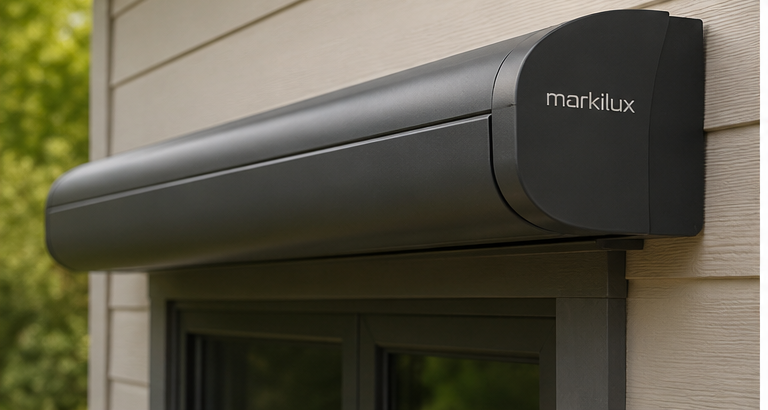
Ask who makes the cassette housing. An enclosed cassette keeps the fabric protected when the awning is retracted. In Rhode Island, that matters when the weather turns in November and you're not rolling it out again until April.
- Who makes the cassette housing? An enclosed cassette protects the fabric through New England winters and keeps debris out when the awning is stored.
- What are the warranty terms for the frame, fabric, and motor? They're usually different. Get all three in writing before you sign anything.
- Does the dealer do the installation, or is it subcontracted? We do our own installs. We'd rather know exactly what went up.
Common Questions
How long does a retractable awning last in Rhode Island?
A quality solution-dyed acrylic fabric lasts 7 to 10 years with basic care in coastal conditions. Budget polyester typically needs replacing in 3 to 4 years. Aluminum frames with powder-coat finishes last 15 to 20 years. See our full awning lineup for the brands we carry and their warranty terms.
Do retractable awnings need to come down for winter?
A motorized awning with an enclosed cassette can stay mounted year-round. The cassette keeps the fabric rolled and protected from freeze-thaw cycles. A wind sensor handles storms automatically. Manual awnings without enclosed cassettes are better fully retracted through the winter months.
Can a retractable awning be mounted on any wall?
It depends on what's behind the wall. The mounting surface has to be structurally solid. We inspect before quoting. Most installs on standard New England construction go up without issue. If you need fabric replacement on an existing frame, we handle that too.
Tiverton, Newport, Portsmouth, Bristol, or anywhere along the coast?
We'll come out and measure your space. We also do awning fabric replacement if you've got a frame that's still in good shape.